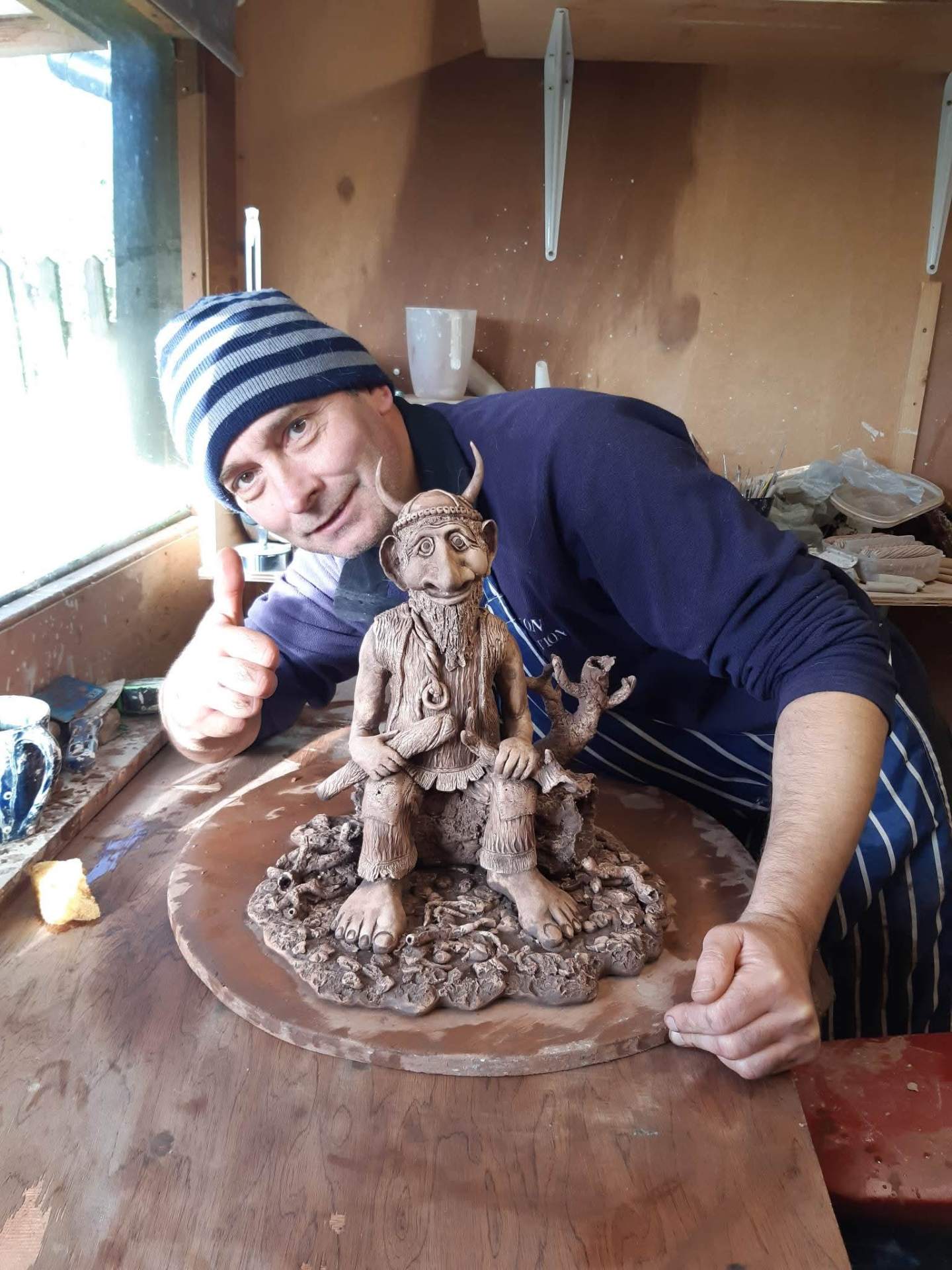
Nick the PotterSgraffito earthenware

The studio.

A workshop in Little Houghton, Northamptonshire, where I've made pots since 1998.

The workshop is a converted barn at the bottom of the garden. It has one north-facing window above the wheel, a wood-burner in the corner that I light most mornings between October and April, and a long bench under the south wall where the pieces sit between stages. The roof is too low in one place — I've hit my head on it for twenty-seven years and I still hit it — and there's a swallow's nest in the eaves that comes back every spring. I've never had any wish to work anywhere else.

I came to clay slowly. I'd done other things — joinery for a while, a stretch of teaching, a long unhappy year in an office in London — and it was only in my late twenties that I sat down at a wheel for the first time. That was at an evening class in Wellingborough. The teacher was a woman called Margaret who'd been at Doulton in the sixties, and she put a lump of red clay in front of me and said almost nothing for the next hour. I went home that evening knowing what I was going to do with the rest of my life. It took another four years to make it happen.

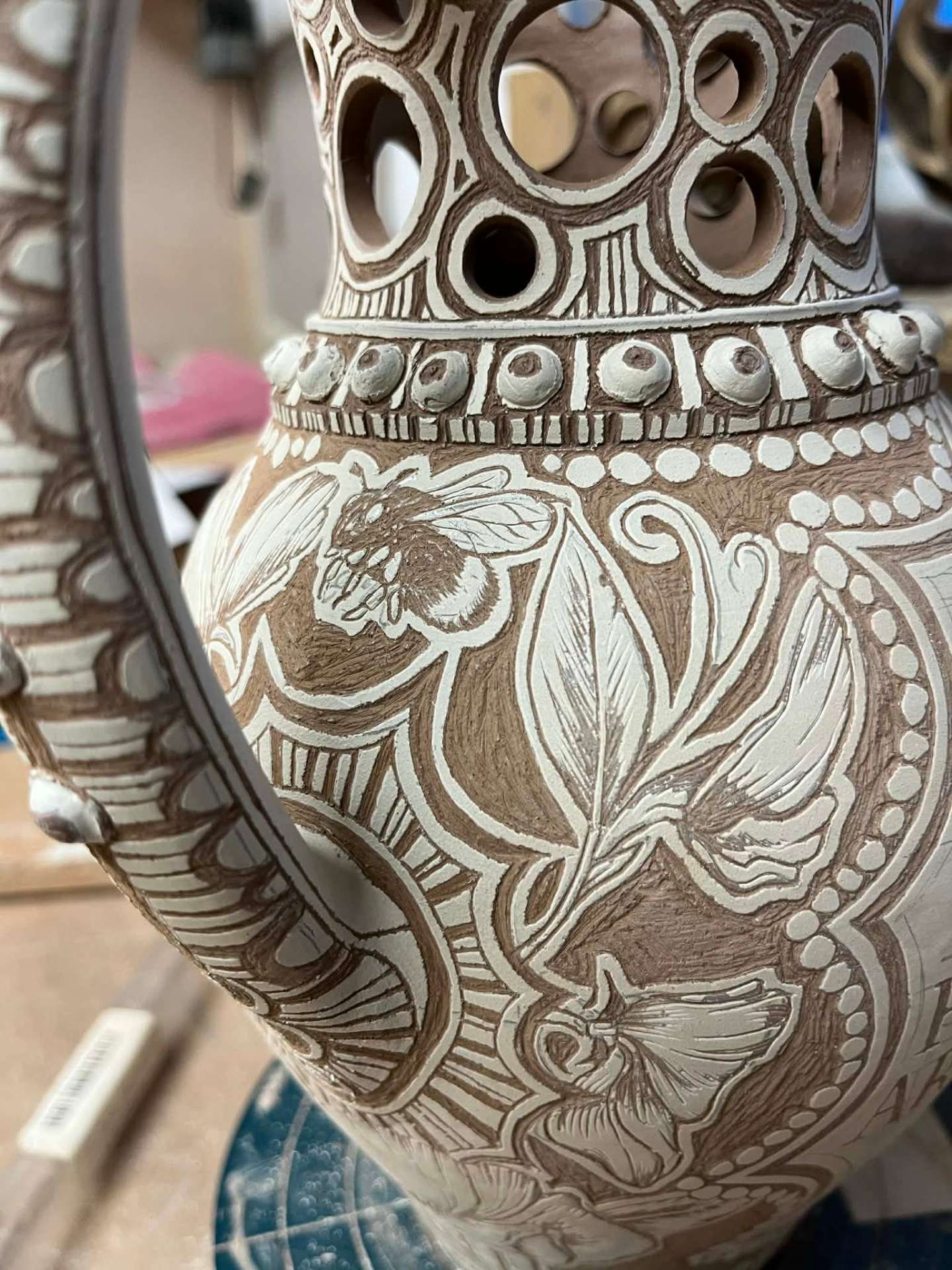
The work I make is sgraffito. It's a simple idea: throw a pot in red earthenware, let it dry to the leather-hard stage, brush a coat of white liquid clay — slip — across the surface, and then, when the slip has set but isn't yet bone dry, scratch back through it with a fine tool to expose the red beneath. Everything that's white is slip; everything that's brown is the body of the pot showing through. There are no paints, no inks, no glazes involved in the drawing itself. Only the cut.

What this means in practice is that the drawing has to be right first time. You can fudge a line in pencil, you can paint over a mistake in oils. You can't unscratch slip. It either reads or it doesn't. I work with a fine pin tool — really just a sewing needle set into a wooden handle — and a small loop for the larger areas, and I draw straight onto the pot without much in the way of preparatory drawing. The letters I do plan; the flowers and bees I mostly don't.

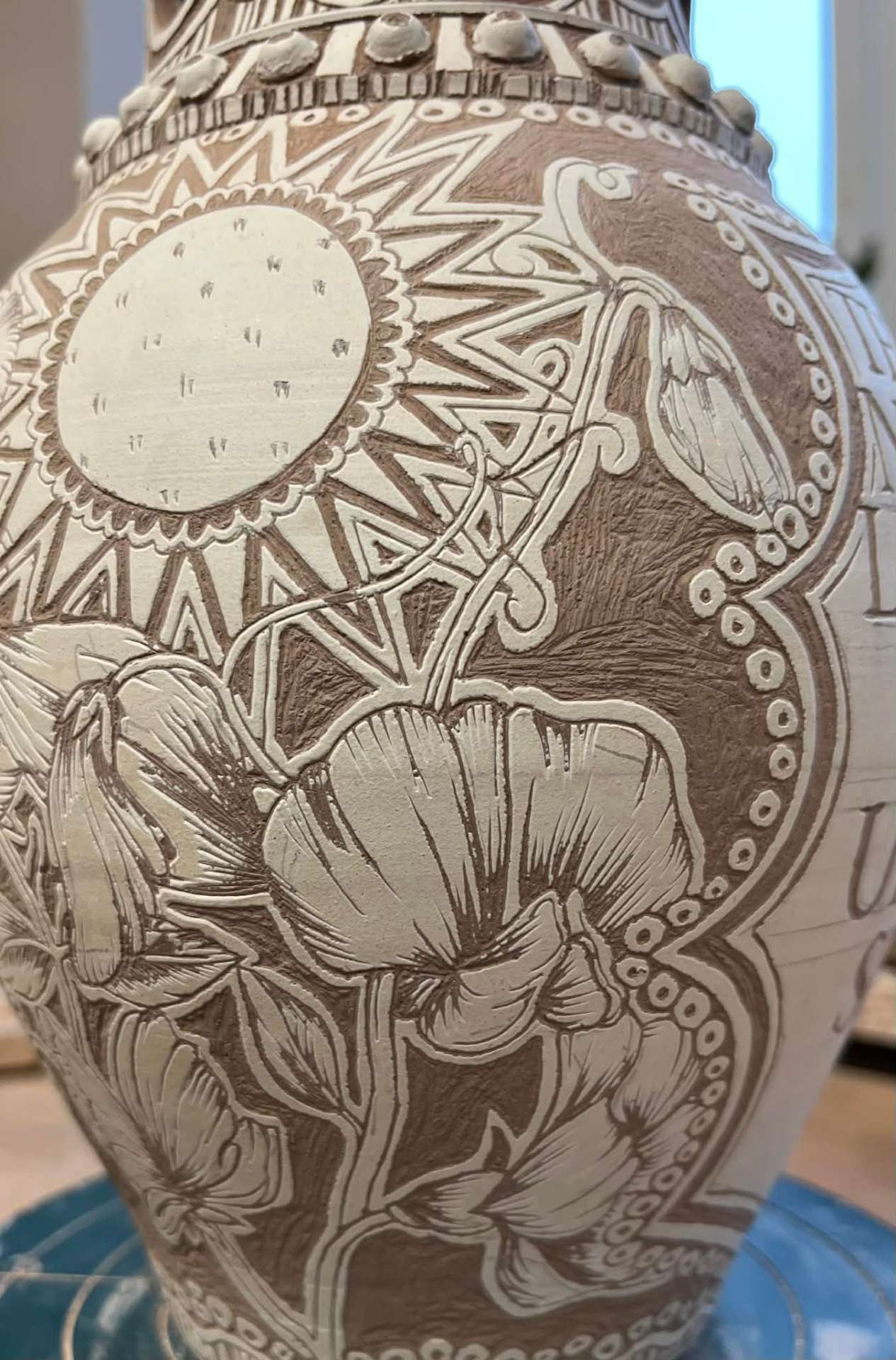
A close view of a poppy panel carved into the slip on one of Nick's vases.
A poppy panel on the Sunshine vase, photographed before bisque firing.

A jug takes between three and six weeks. The throwing is the fastest part — an hour, two at most. Then the body needs to firm up before the handle and the rim work can go on; that's two or three days under plastic, checked every morning. Then slipping, which is straightforward but has to be done in two or three coats, with drying time between each. And then the carving, which is the long part. A jug like the Half Crazy one will take eight or nine full days at the bench to carve.

I work to music in the mornings — usually something with words I know well enough to ignore — and in silence in the afternoons. The dog is in and out. Visitors come on Wednesdays and Saturdays, by appointment, and on those days I try to be carving something interesting so there's something to watch. Most days nobody comes, which suits the pots fine.

A few years ago I started inscribing pieces with fragments of old songs — music hall numbers, drawing-room ballads, the things my father used to whistle. The Daisy Bell jugs came out of that. There are now four of them, each carrying a different line of the song, and they go together when they stand on a shelf. People sometimes ask whether I'll ever finish the set. I might. I might not.

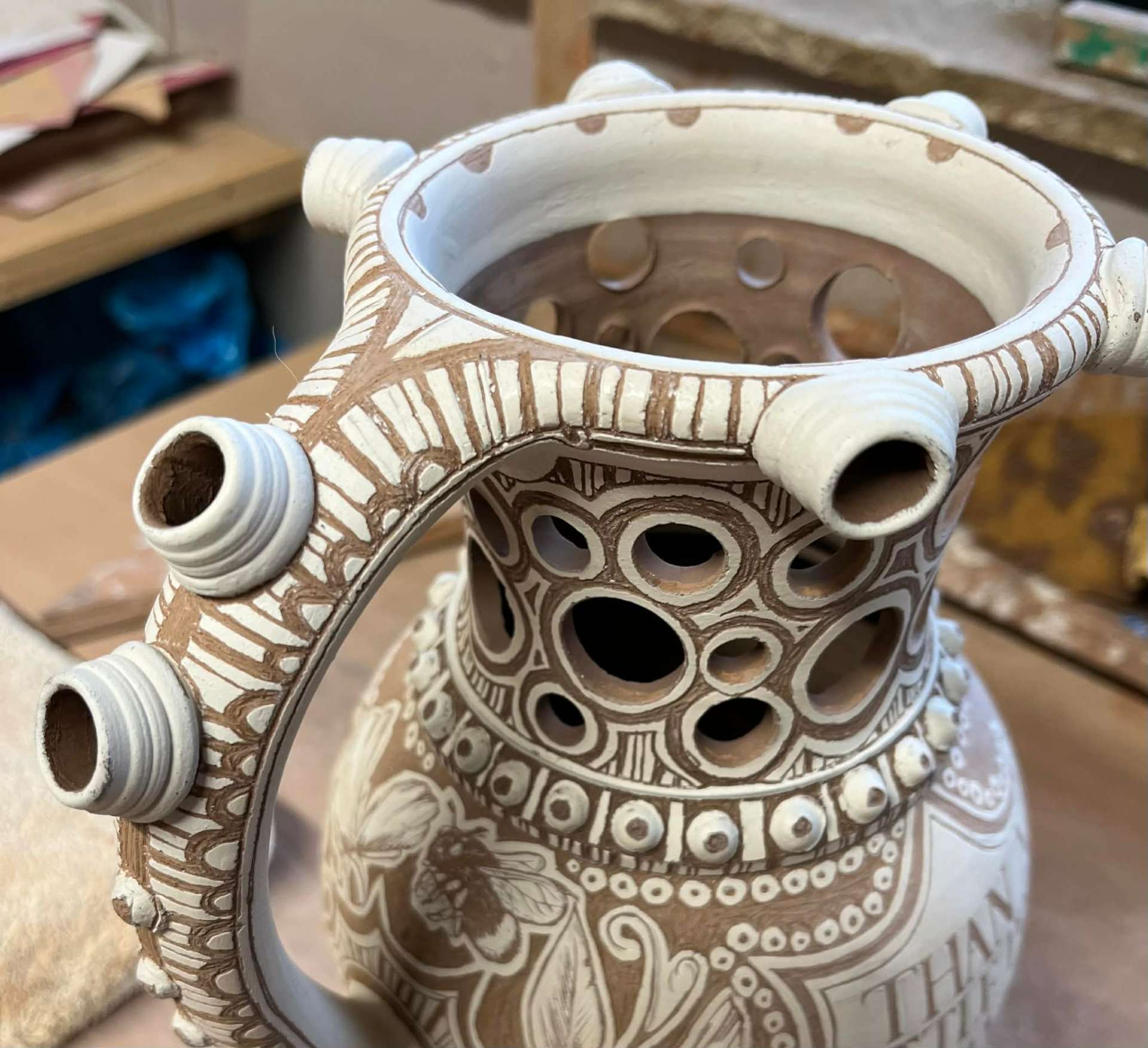
The openwork rim of a vase, with rolled cane-loops at the points.
The openwork collar of the Sunshine vase, built up by hand over two evenings.

"I'd rather make one good jug a month than thirty bad ones. The point of doing it this slowly is the slowness."

Influences and tradition.

Sgraffito as I make it comes out of the late-Victorian English slipware revival, and particularly out of the Doulton Lambeth studios of the 1870s and 80s. Hannah Barlow's incised animals are the great touchstone — she could put a sheep onto a jug in three lines and you'd know which sheep — and her brother Arthur Barlow's foliage panels are still about as good as the form gets. The Martin Brothers, in Southall, were doing strange and wonderful things at the same time.

Closer to now, I owe a great deal to Phil Rogers, who I never met but whose pots I've handled often enough to feel I did. And to Margaret in Wellingborough, who put the first piece of clay in front of me and let me get on with it.